Applications
Carbon Fiber Tube Applications
How carbon fiber tubes serve beams, shafts and lightweight structures, with guidance on manufacture, layup, joints and selection.
Why Tubes Are Structurally Efficient
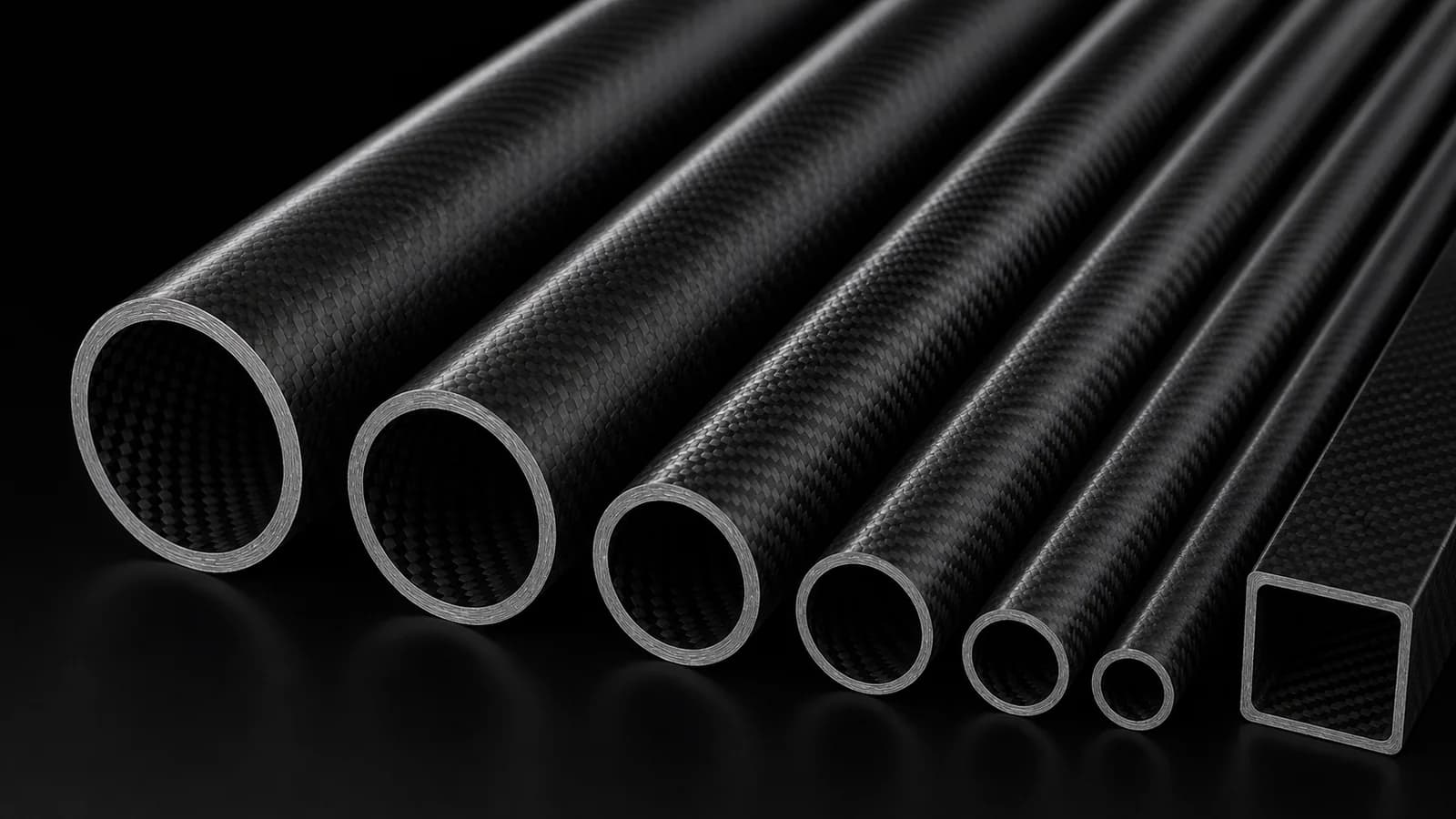
A tube places material away from its neutral axis, making the section efficient in bending and torsion for its mass. Carbon reinforcement can then be oriented along the axis, around the circumference or at angles to support the expected load mix.
Axial fibers support tension, compression and bending; off-axis or circumferential reinforcement helps torsion, hoop loads, splitting resistance and local joints. The required balance depends on span, diameter, wall and interfaces.
Pultruded and Roll-Wrapped Tubes
Pultrusion continuously pulls reinforcement through resin and a heated die to produce a constant profile. It is efficient for long tubes, rods and profiles with a strong axial-fiber contribution, while transverse reinforcement depends on the product design and process.
Roll-wrapped tubes are built by wrapping prepared layers around a mandrel before cure. The method allows greater control of ply angles, wall construction and tapered or application-specific reinforcement, subject to tooling and process capability.
Common Tube Applications
Typical uses include UAV arms, robotic links, lightweight frames, camera and sensor supports, industrial rollers, drive or torsion members, sporting equipment and telescoping structures.
Each application emphasizes different behavior. A positioning beam may prioritize deflection and thermal stability, while a shaft needs torsional behavior, balance and reliable end fittings.
Dimensions, Machining and End Connections
Select outside and inside diameter, wall thickness, length, straightness, surface and laminate around functional loads and available mating parts. Fit between telescoping tubes must account for manufacturing variation and surface protection.
Drilling and slotting can weaken a tube locally. Bonded plugs, sleeves, clamps or designed inserts can spread load, but require adequate overlap, surface preparation, bond-line control and validation.
Frequently Asked Questions
Is a pultruded tube suitable for torsion?
It depends on its reinforcement architecture. Products dominated by axial fibers may be less efficient in torsion than tubes designed with angled or circumferential reinforcement.
Can carbon fiber tubes be drilled?
Yes, with appropriate tooling, support and dust control. Hole location, edge distance and local reinforcement should be reviewed because drilling interrupts fibers and can initiate splitting.