Carbon Fiber Basics
What Is Carbon Fiber?
A practical introduction to carbon fiber, composite structure, material behavior, product formats and engineering selection.
What Is Carbon Fiber?
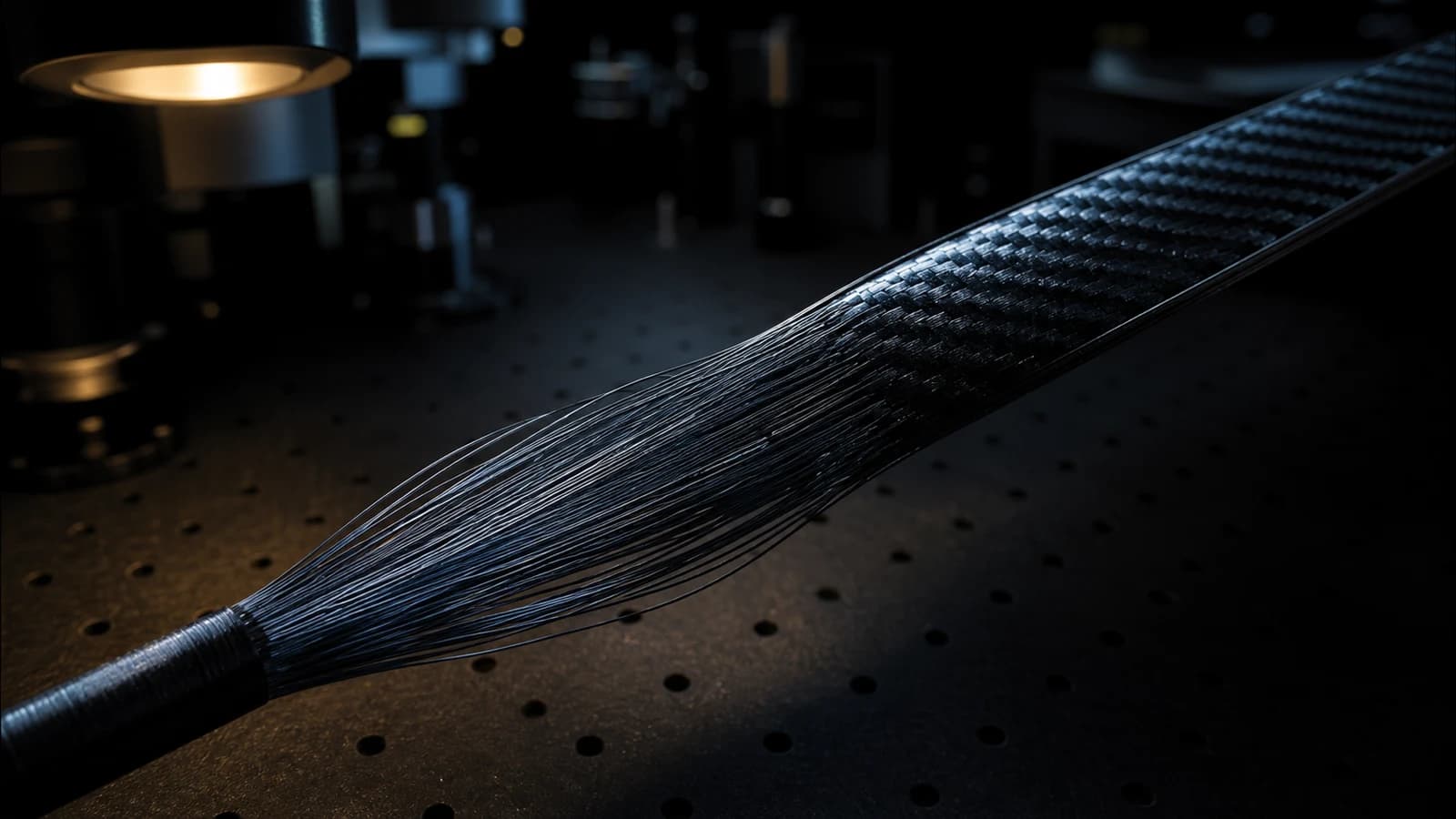
Carbon fiber is a family of fine, carbon-rich filaments. The filament is the reinforcement; most finished parts are carbon-fiber-reinforced polymers, or CFRP, in which fibers carry much of the structural load and a resin binds and protects them.
This distinction matters because fiber properties alone do not describe a finished tube, sheet or machined part. Resin system, fiber volume, orientation, laminate sequence, geometry, manufacturing quality and service environment all influence component performance.
How Carbon Fiber Is Made
Most commercial carbon fiber begins with a polymer precursor. It is stabilized and then heated under controlled conditions to remove non-carbon elements and develop carbon-rich filaments. Producers gather the filaments into tows and apply a compatible surface treatment or sizing.
Composite manufacturers then use the fiber as woven fabric, unidirectional reinforcement, prepreg or another intermediate form. The reinforcement is shaped, combined with resin and cured by a process suited to the required geometry, surface, consistency and production volume.
Carbon Fiber Structure
A carbon filament is highly directional: it carries tensile load most efficiently along its length. A laminate therefore behaves differently in different directions unless its layers are deliberately arranged to distribute loads across several orientations.
Engineers select ply angles and stacking sequence around axial, bending, torsional and local loads. Symmetry, balance, joints, cutouts and edge conditions also matter, so a visible weave pattern should never be treated as a complete structural specification.
Key Properties
CFRP is often selected for low mass, high specific stiffness and strength, corrosion resistance and dimensional stability. These benefits can enable lighter moving structures, stiff panels and components that retain performance in environments where unprotected metals may corrode.
The material also has limitations. It is anisotropic, electrically conductive, sensitive to impact and edge damage, and dependent on the resin at elevated temperature or in fire. Design decisions must use laminate-level data relevant to the actual product and process.
Common Carbon Fiber Weaves
Plain weave alternates each tow over and under the next, creating a stable fabric with a compact checkerboard appearance. A 2x2 twill passes over two and under two, producing a diagonal pattern and generally improving drape over curved tooling.
Unidirectional material concentrates reinforcement in one primary direction and is useful when loads are clearly defined. Weave choice affects handling, formability and appearance, but fiber grade, areal weight, resin and laminate design remain equally important.
Common Carbon Fiber Products
Standard forms include laminated sheets and plates, roll-wrapped or pultruded tubes, pultruded rods and profiles, molded components and CNC-machined laminate parts. Each format reflects a different balance of fiber direction, geometry and manufacturing efficiency.
Stock material can shorten lead time for straightforward designs. Custom laminates or molded parts are more appropriate when fiber orientation, wall construction, inserts, surface finish or integrated geometry must be tailored to a specific load case.
Applications
Carbon fiber composites are used in aerospace structures, vehicles, UAVs, robotics, industrial automation, measuring equipment, sporting goods and selected medical or consumer products. Typical goals include reducing moving mass, increasing stiffness or controlling deflection.
Suitability depends on more than sector. Engineers should evaluate load spectrum, impact risk, temperature, moisture, chemicals, electrical behavior, joining, inspection, repair and production quantity for the individual component.
Carbon Fiber vs Traditional Materials
Compared with aluminum or steel, CFRP can deliver more stiffness or strength per unit mass in favored fiber directions. Metals, however, are generally isotropic, familiar to machine and form, and often easier to inspect, join and repair.
A fair comparison uses equivalent functions rather than equal thickness. Section geometry, load path, allowable deflection, safety factors, connections, operating environment, tooling and lifecycle requirements should be compared at component level.
How to Choose the Right Carbon Fiber Product
Begin with the function: expected loads and directions, unsupported span, space and mass limits, operating environment and required service life. Then define interfaces, dimensions, critical tolerances, holes, edge distances, surface expectations and production quantity.
Provide drawings or CAD data where possible and identify which requirements are critical. A manufacturer can then review laminate type, material form, manufacturing route, machining strategy, inspection method and whether prototype validation is appropriate.
Frequently Asked Questions
Can carbon fiber be selected by appearance alone?
No. Two parts with a similar weave can have different fibers, resin systems, ply orientations and quality. Selection should be based on the complete laminate and service requirement.
Is every carbon fiber product stronger than metal?
No. Performance depends on load direction, geometry, laminate and failure mode. CFRP can be very efficient in a designed load path, while a metal may be more suitable for impact, bearing, heat or complex multidirectional loading.