
Comparison
Carbon Fiber vs Steel
A component-level comparison of carbon fiber composites and steel for weight, loading, durability, fabrication and lifecycle decisions.
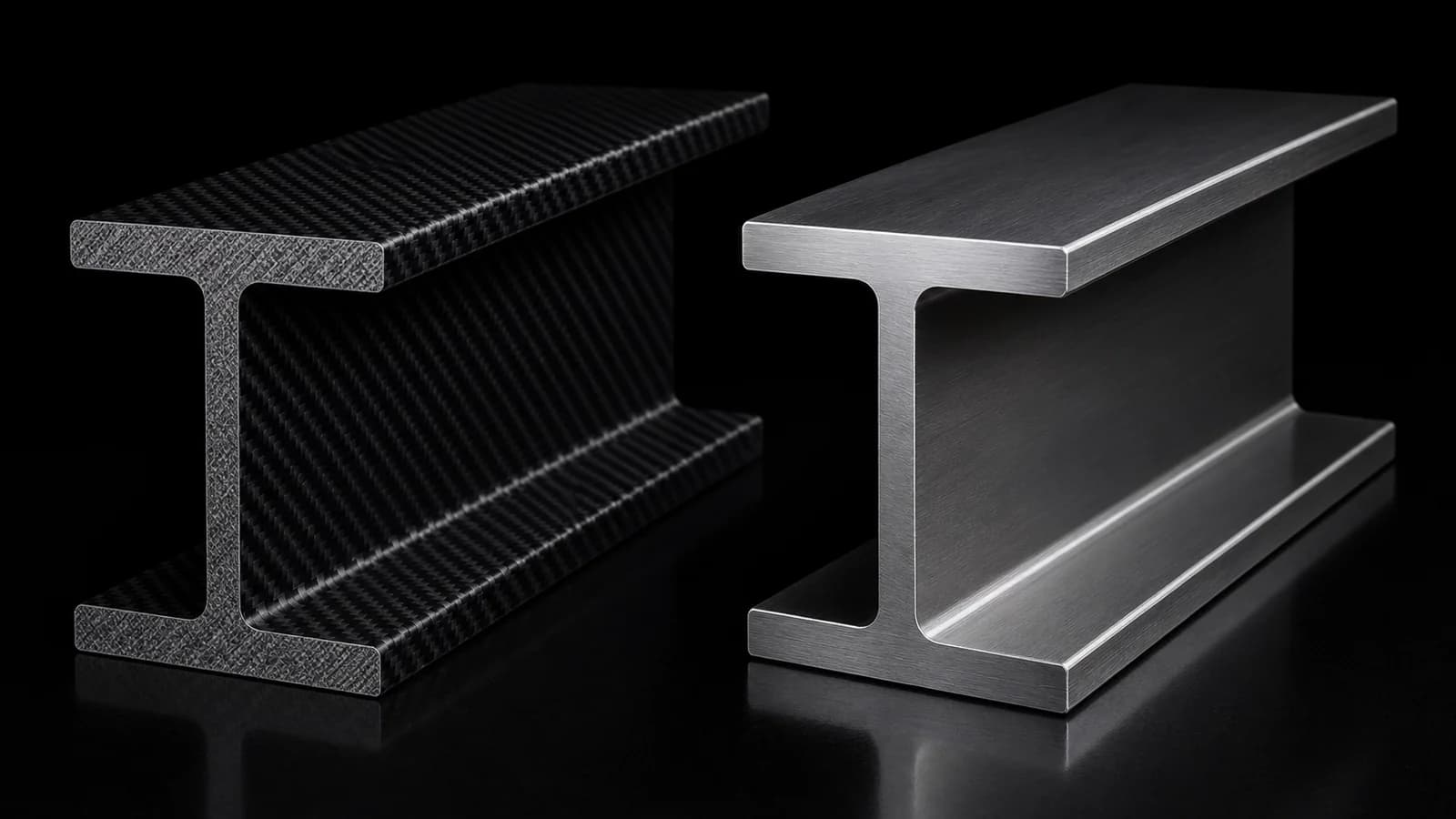
Mass, Strength and Stiffness
Steel provides high absolute stiffness, strength and predictable isotropic behavior, but at greater density. A designed CFRP laminate can reduce mass substantially while placing reinforcement along dominant load directions.
The outcome is geometry-dependent. Thin composite skins may require cores, ribs or larger sections to prevent buckling, while a compact steel part may carry concentrated bearing, thread or contact loads efficiently.
Failure Behavior and Durability
Steel commonly yields before final failure and can tolerate local dents or plastic deformation. CFRP usually has lower ductility and may develop matrix cracking, delamination, fiber fracture or hidden impact damage depending on the event.
CFRP resists electrochemical rust, but the resin and interfaces still govern temperature, moisture and chemical resistance. Fire behavior, wear, erosion and inspection access should be evaluated for the service environment.
Production, Joining and Maintenance
Steel benefits from mature forming, welding, casting and machining routes. Composite production introduces laminate design, molds, cure control and careful trimming, although near-net-shape molding can consolidate complex features in suitable volumes.
Metal inserts and fasteners can transfer local loads into CFRP, but bearing stress, edge distance and galvanic compatibility need attention. Maintenance planning should define damage acceptance, inspection and feasible repair before deployment.
Making the Material Decision
Choose CFRP when reducing mass or inertia, tailoring stiffness, or avoiding corrosion creates system-level value. Choose steel when compact load introduction, high-temperature capability, wear resistance, ductility or low-cost fabrication is more important.
A structured trade study should compare finished components, including tooling, secondary operations, coating, assembly, inspection, expected damage and end-of-life considerations—not just raw material price.
Frequently Asked Questions
Is CFRP always stronger than steel?
No. Strength depends on the specific materials, fiber direction, geometry and load case. CFRP can have excellent specific properties, while steel may be superior for local, multidirectional, high-temperature or ductile loading.
Can steel fittings be used with carbon fiber?
Yes, when the joint is engineered for load transfer, bearing, sealing and corrosion control. The insert geometry and laminate around it are part of the structural design.