
Comparison
Carbon Fiber vs Aluminum
An engineering comparison of CFRP and aluminum covering structural efficiency, environment, manufacturing, joining and selection.
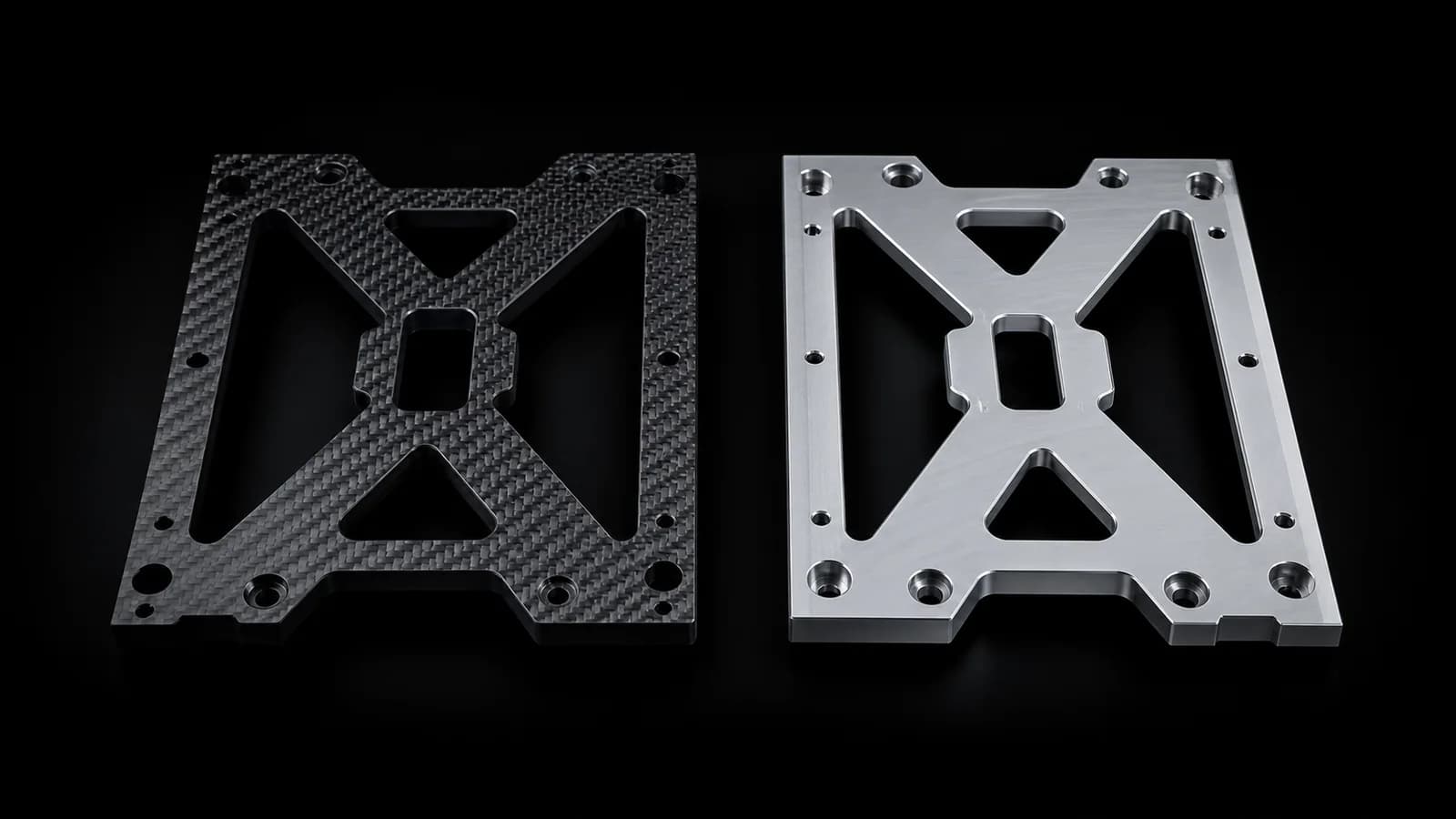
Structural Efficiency and Load Direction
Carbon fiber laminates can provide high stiffness and strength relative to mass when fibers follow the principal load paths. Aluminum has lower directional design freedom but behaves more uniformly in different directions and is supported by familiar grade-based data.
Equal-thickness coupons are rarely a useful design comparison. A fair assessment considers the complete section, deflection limit, buckling, joints, cutouts, impact, fatigue spectrum and safety factors for the actual component.
Environmental and Thermal Considerations
CFRP does not rust, but resin selection and moisture, ultraviolet exposure, chemicals and temperature still require review. Aluminum forms a protective oxide yet may corrode in aggressive environments or at crevices and dissimilar-material interfaces.
Carbon fibers are electrically conductive and can drive galvanic corrosion when directly coupled to aluminum in the presence of an electrolyte. Isolation layers, compatible fasteners, sealants, drainage and controlled joint design may be required.
Manufacturing, Joining and Repair
Aluminum can be cut, formed, welded or machined using widely available processes. CFRP needs laminate manufacture before trimming and drilling, and machining must control abrasive tool wear, dust, heat and edge damage.
Composite joints may be bonded, mechanically fastened or hybrid. Bearing loads, adhesive preparation, inserts and inspectability must be designed rather than copied from a metal part. Repair methods also depend strongly on laminate access and damage type.
When to Choose Each Material
CFRP is attractive when mass, controlled stiffness, corrosion resistance or low inertia dominate and production justifies the material and process. Aluminum is often effective for ductile behavior, thermal conduction, simple fabrication, economical prototypes or complex metallic interfaces.
Hybrid construction is common. The best choice may combine a carbon structure with isolated aluminum inserts or fittings, provided load transfer, galvanic protection and differential thermal movement are addressed.
Frequently Asked Questions
Which material is lighter?
CFRP laminates are generally less dense than common structural aluminum alloys, but the meaningful question is the mass of two components designed to meet the same loads, stiffness, joints and durability requirements.
Can carbon fiber contact aluminum directly?
Direct contact should be reviewed carefully. In wet or conductive environments, electrically isolating the materials and sealing the joint helps manage galvanic-corrosion risk.