Materials
2x2 Twill vs Plain Weave
A practical guide to how 2x2 twill and plain weave differ in handling, appearance and laminate use.
How the Weaves Are Constructed
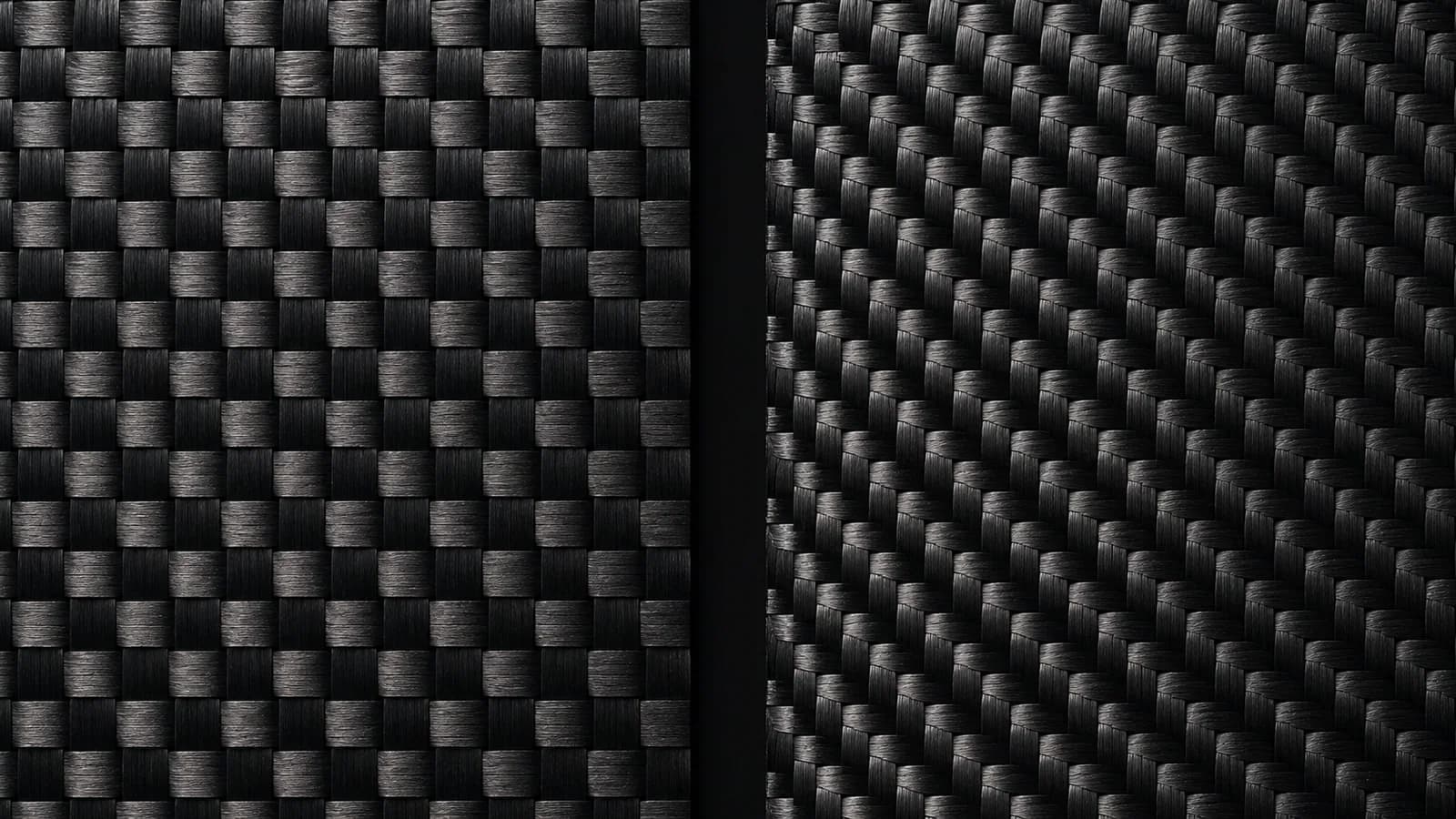
Plain weave alternates each warp tow over and under each weft tow. The frequent interlacing stabilizes the fabric and creates a small checkerboard pattern, but also produces more fiber crimp.
In 2x2 twill, a tow passes over two and under two, with the pattern offset to form diagonal lines. The longer float generally makes the fabric more compliant when laid over curved or contoured tooling.
Drape, Stability and Processing
Plain weave is stable during cutting and handling, which can help alignment on flat or gently curved laminates. Its tighter construction can make it less willing to conform to compound curves without bridging or distortion.
Twill drapes more readily but may shift or fray if handled carelessly. Cutting templates, backing paper, controlled debulking and experienced layup practice help preserve orientation and surface consistency.
Structural Meaning of the Pattern
Both fabrics usually contain reinforcement in two principal directions, but weave alone does not define laminate performance. Fiber grade, tow size, fabric weight, resin content, ply count, orientation and cure quality remain decisive.
A cosmetic outer ply may be selected for appearance while internal unidirectional or woven plies carry structural loads. The complete laminate specification should therefore be separated from the visible surface choice.
Choosing Twill or Plain Weave
Choose based on tool curvature, handling needs, visual requirement and laminate design. Plain weave often suits stable flat layup and a compact technical appearance; twill is often preferred for drape and its recognizable diagonal finish.
For structural parts, confirm that the chosen fabric and ply orientations support the load case. Samples can help assess pattern scale, distortion, gloss level and acceptable cosmetic variation before production.
Frequently Asked Questions
Is twill stronger than plain weave?
Not inherently. Comparable fabrics can behave differently because of crimp and construction, but finished performance depends on the entire laminate and test direction.
Can the surface weave be cosmetic only?
Yes. A thin woven outer layer can provide the desired appearance while structural layers underneath are designed for the loads.