Design
How to Choose Carbon Fiber Sheet Thickness
A design-led method for selecting carbon fiber sheet thickness from load, span, laminate, machining and validation needs.
Start with Load and Deflection Requirements
Sheet thickness should follow the component function, not a visual preference. Define supported span, load magnitude and direction, acceptable deflection, vibration, buckling risk, impact exposure and safety requirements.
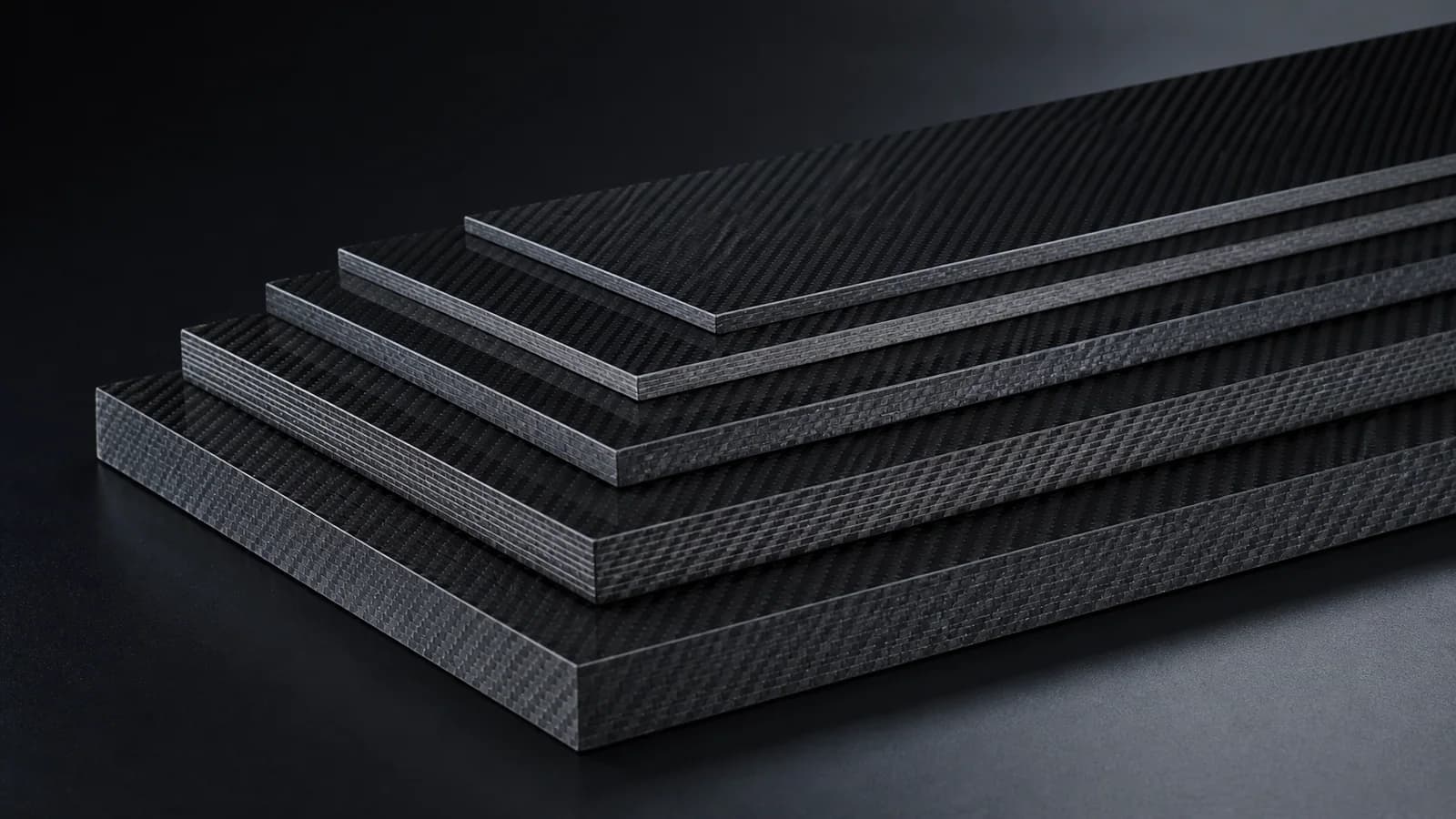
Bending stiffness changes strongly with section thickness, but boundary conditions and geometry are equally important. Ribs, flanges, sandwich cores or shorter spans may improve stiffness more efficiently than simply adding solid laminate.
Thickness Does Not Define the Laminate
Two sheets with the same nominal thickness may contain different fibers, weave styles, ply orientations, resin content and consolidation quality. Their directional stiffness, strength, flatness and machining behavior can therefore differ.
Specify the required structural behavior and surface, then confirm the supplier's laminate construction or verified material data. Quasi-isotropic, woven and directionally reinforced sheets serve different load cases.
Account for Holes, Edges and Interfaces
Holes, slots, narrow webs and fasteners create local stresses that may govern the design. Thickness must be reviewed together with edge distance, bearing area, washer or insert design, countersinks and the direction of nearby fibers.
CNC machining also needs sufficient material for reliable workholding and edge quality. Very thin sheets can vibrate or lift; thick laminates may need different tools and entry strategies to limit heat and delamination.
Use Prototypes and Engineering Validation
For noncritical covers or cosmetic panels, comparison with a proven design may be sufficient. Structural, safety-related or tightly controlled components require engineering calculations and, where appropriate, representative testing.
A prototype can verify deflection, interfaces, hole quality, assembly and visual finish. Record the exact material and process used so the validated configuration can be reproduced.
Frequently Asked Questions
Can thickness be selected from part weight alone?
No. Weight is only one constraint. Span, load path, allowable deflection, laminate construction, joints and environment must also be defined.
Is a thicker sheet always the best solution?
No. It may add cost and mass without addressing load transfer or buckling. Geometry, support and fiber orientation can be more effective design variables.