Machining
How to CNC Machine Carbon Fiber
Core practices for cutting cured CFRP while controlling dust, tool wear, heat, delamination and edge quality.
Understand the Machining Behavior of CFRP
Cured CFRP is a heterogeneous laminate: hard abrasive fibers are supported by a comparatively softer polymer matrix. Cutting can create fiber pull-out, uncut fibers, edge breakout, delamination or resin heat damage if the process is unstable.
Machining strategy should reflect laminate thickness, fiber architecture, coating, geometry and quality requirement. Parameters proven on one grade or layup should not be transferred blindly to another.
Tooling, Support and Workholding
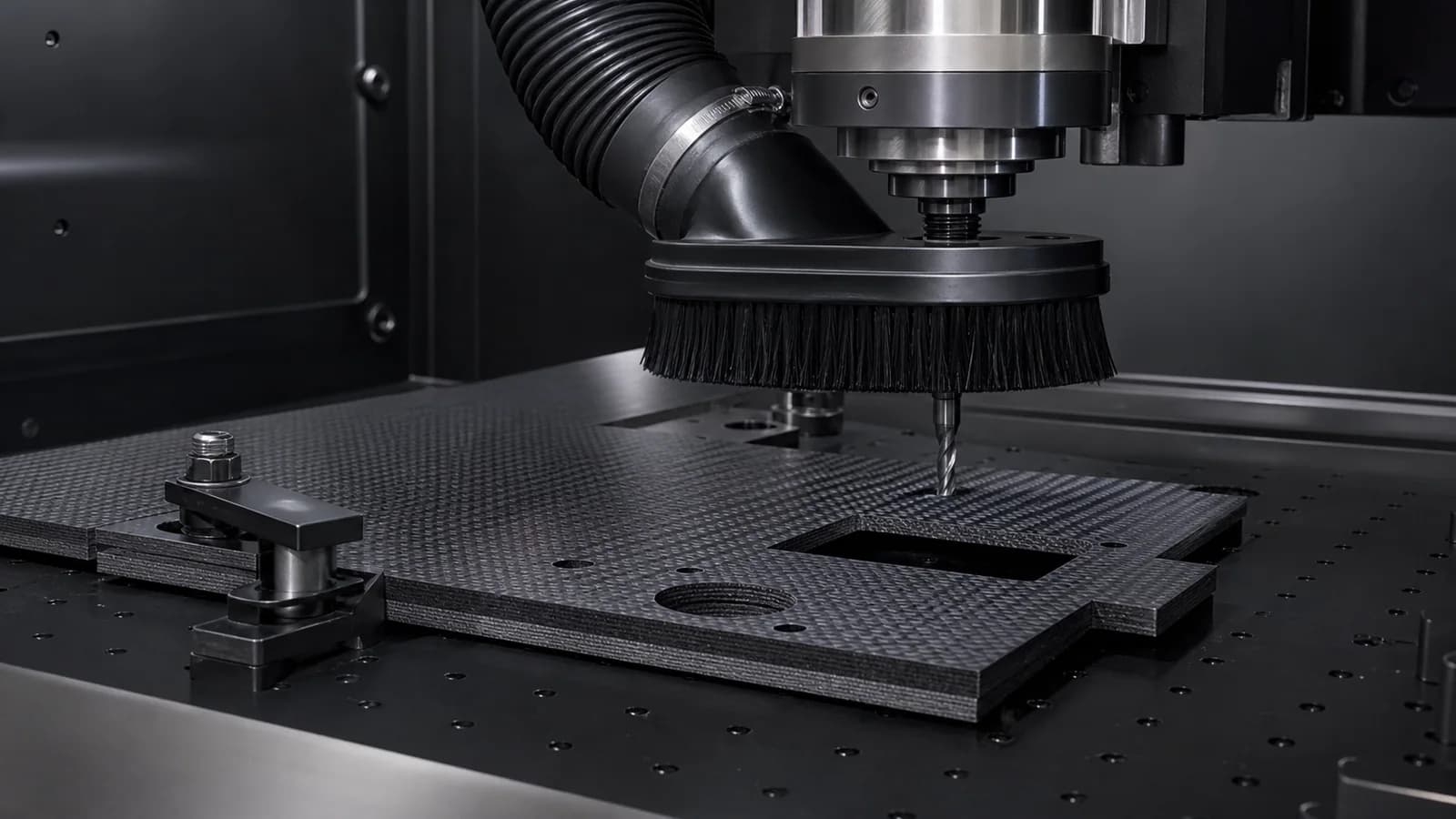
Sharp, wear-resistant tools designed for composites help control cutting forces and edge quality. Tool geometry and entry direction should suit drilling, routing, trimming or countersinking, and wear should be monitored rather than judged only after defects appear.
Support the laminate close to the cut and use workholding that prevents lift, vibration and surface marking. Sacrificial backing, suitable fixtures and controlled toolpaths are especially important around holes, thin sheets and free edges.
Dust Control and Operator Safety
Machining creates fine conductive dust and fragments. Enclose the process where practical and capture dust at source with equipment suitable for the machine, material and applicable safety rules.
Risk assessment should address inhalation, skin contact, housekeeping, electrical equipment and disposal. Operators need site-approved training and protective measures; compressed-air cleaning can redistribute dust and should be avoided unless a controlled procedure permits it.
Control Heat, Delamination and Inspection
Use stable cutting conditions that remove material cleanly without excessive rubbing or heat. Feed, speed, depth of cut and toolpath must be developed for the specific machine, tool, laminate and feature rather than copied from a universal table.
Inspect entry and exit edges, hole diameter, breakout, delamination, burrs and surface damage. First-article checks and recorded tool life help maintain consistency across a batch.
Frequently Asked Questions
Can standard metal-cutting tools be used?
They may cut CFRP briefly, but abrasive fibers can wear unsuitable edges quickly and reduce quality. Composite-specific tooling and validated parameters are generally more controllable.
Should coolant be used?
The answer depends on the laminate, coating, machine and downstream requirements. Many processes use effective dry extraction; any coolant must be verified for material compatibility, contamination and dust-control implications.