Materials
What Is Quasi-Isotropic Carbon Fiber?
An explanation of quasi-isotropic laminates, balanced ply directions, limitations and appropriate design use.
What Quasi-Isotropic Means
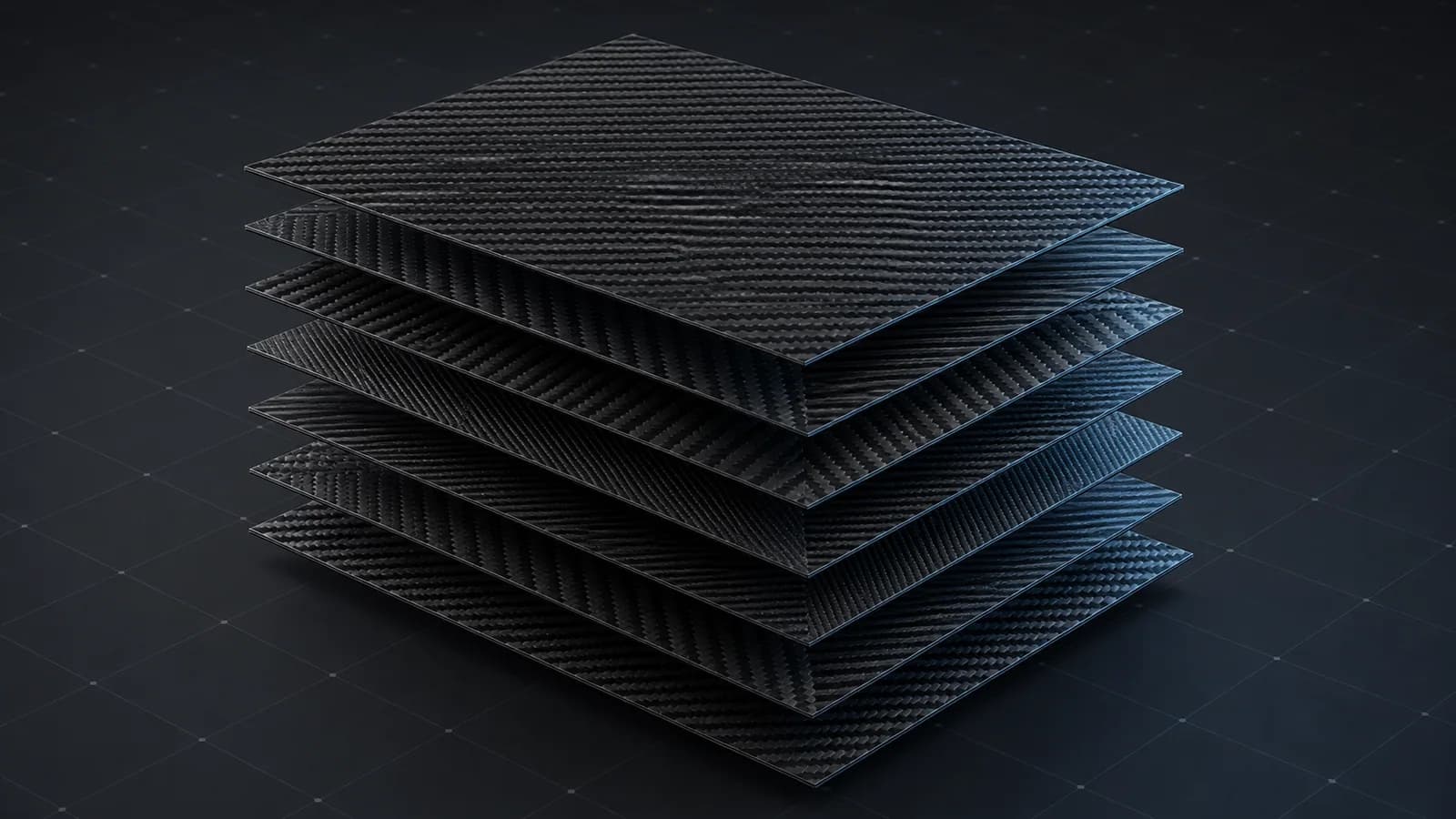
A quasi-isotropic laminate combines several fiber directions so its in-plane response approximates similar behavior across multiple directions. It is still a layered composite—not a truly isotropic material like an idealized homogeneous metal.
The term describes laminate behavior within defined assumptions. Exact stiffness and strength remain dependent on fiber, resin, ply thickness, stacking sequence, manufacturing quality and loading mode.
Ply Directions, Balance and Symmetry
Designers commonly distribute reinforcement among axial, transverse and positive or negative angled directions. Balanced angled plies help control coupling under in-plane loads, while a symmetric sequence can reduce unwanted bending-extension coupling.
There is no universal quasi-isotropic stack for every part. Curvature, holes, joints, local loads, minimum ply rules and manufacturing constraints may require additional reinforcement or a different sequence.
Important Limitations
Quasi-isotropic in-plane behavior does not eliminate weaker through-thickness properties. Interlaminar stresses, impact damage, delamination, bearing and free-edge effects still require specific attention.
The label also does not guarantee equal properties after machining. Cutouts interrupt fibers, and narrow features may contain an uneven share of the intended directions.
When to Use a Quasi-Isotropic Laminate
This approach is useful when load directions vary, the design is still evolving or a general-purpose plate must support multidirectional in-plane loads. It can simplify early design compared with a highly specialized directional layup.
Where a dominant load path is well understood, a tailored laminate may offer better mass efficiency. Final selection should use analysis and validation appropriate to the component risk.
Frequently Asked Questions
Is woven carbon fiber automatically quasi-isotropic?
No. A woven ply normally reinforces two directions, while quasi-isotropic behavior requires a considered distribution of multiple orientations through the laminate.
Does quasi-isotropic mean equal strength in every direction?
No. It generally refers to an approximation of in-plane elastic behavior. Strength, out-of-plane response and local details can remain strongly directional.